| Go to key words |
OTHER RESOURCES: telemedicine, hospital ships, medical guides ...
| This
type of ships carry out radio-medical consultations, as
well as consultations on board those boats where medical
attention is required, and take patients to the hospital
ship when necessary. They also coordinate aerial or
marine evacuations and make mechanical, electronic, or
propeller repairs. The I.S.M.
(Mariners’ Social Institute) permanently maintains
the health care and logistics support ship "Esperanza
del Mar" in the fishing ground between the
Canary Islands and the Sahara area. During the tuna
fishing season in the months of June, July and August,
the I.S.M. locates a hospital ship in the North Atlantic
to back up the large Spanish fishing fleet. In recent
years the boat chartered for this has been the
"Remolcagure Bat" although, since it is subject
to rent, this may change, so it has been decided to use
the generic name "Sanimar". For information on RADIO-MEDICAL CONSULTATION CENTRES: go to Unit 2 |
 |
| COORDINATION, EVACUATION, REPATRATION AND OTHER MEASURES |
| MARINE
RESCUE HELICOPTERS Sometimes the
rescue of survivors from the water or a lifeboat must be
carried out with a helicopter which, if possible, should
be equipped with dual controls, gas biturbine, a crane
for maneuvers, basic life support facilities and
specialized health care personnel. In Spain the "Helimer"helicopters
of the "Sociedad Estatal de Salvamento
Marítimo" (State Marine Rescue Organization) have
specialized personnel, even for immersions, and can give
aid from the water to survivors who are in such a
physical state that they cannot attach themselves to
suspension devices from the helicopter. The use of
helicopters in an emergency will be determined by the
distance to the coast from the scene of the accident,
since their range without refueling is only 180 miles in
the best of cases. Evacuating
people with a helicopter requires suitable
coordination between both parties involved. At great
distance, communications between ship and helicopter will
take place by radio, and when they are within sight of
each other they will additionally use the signals
prescribed for these cases in the International Signal
Code since helicopter rotors cause a high level of noise
and an air turbulence below which prevent the oral
transmission of orders. Whatever equipment
is used to hoist survivors (sling, basket, net, seat): - these must wear
life jackets throughout the operation, even during the
flight and until they leave the helicopter, with the only
exception of those victims whose state could deteriorate
by using them. - they must not
wear loose clothing or personal belongings that can be
sucked in by or dragged towards the helicopter's rotors
or engines. - they must not
touch the hook on hoisting equipment unless its potential
electrostatic charge has previously been earthed. - in case of
dysbaric diving accidents, transfer must include medical
attention, maintaining health care measures initiated at
the scene of the accident as well as normobaric
conditions: thus the helicopter must not exceed a maximum
altitude of 100-150 metres in flight.
HYPERBARIC (COMPRESSION) CHAMBERS Diving accidents
involve a specific pathology which usually requires
recompression treatment with oxygen given in so-called
hyperbaric chambers. A list of existing
hyperbaric chambers in Spanish territory together with
further information can be found on the Web page of the Comité Coordinador de Centros de Medicina
Hiperbárica (Coordinating Committee of Hyperbaric
Medicine Centres). The following
Centres, despite not being health care institutions,
coordinate any type of maritime emergency and put the
captains in contact with health care personnel suitable
for each situation: In Spain: Telephone
numbers: (+34) 900 202202; 91 5964988; 91 5964989 World-wide: Telephone:
00 (or international access code) 33 297 553535 Ask to speak to the
"Chef de quart" (area manager). Explain the
case, and give boat's position and telephone number. They
will call back to check data and coordinate the whole
evacuation process.
MEDICAL
GUIDES FOR SHIPS In 1948 the
International Labour Organization (ILO) and the World
Health Organization (WHO) decided to set up a joint
Committee, the Committee for Sailors' Hygiene, to study
the health problems of maritime workers. At a meeting of
this Committee in Geneva in 1965, the decision was taken
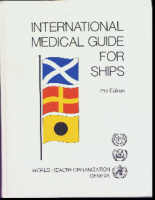
to publish an "International Medical Guide for Ships" to facilitate
guidelines for health care at sea, and also containing
instructions on the optimum use of on-board medical
supplies and the International Signal Code (reforming the
part related to medical attention), and also on the
transmission of the messages in radio consultations. This joint
Committee pointed out the twofold utility of the
International Guide; on the one hand, that it should be
distributed to vessels belonging to countries which did
not have their own medical guide, and on the other hand,
it was suggested that those countries which had a
national guide should take the international proposal
into consideration when writing up their respective
guides. In September 1981
the joint Committee (ILO-WHO), at a meeting in Geneva,
revised the technical contents of the guide and some
necessary changes were discussed. The Committee included
representatives of the International Maritime
Organization, sailors, shipbuilders, and experts in
maritime medicine, as well as ILO and WHO staff. This led
to the latest edition of the "International
Medical Guide for Ships" in 1988, later
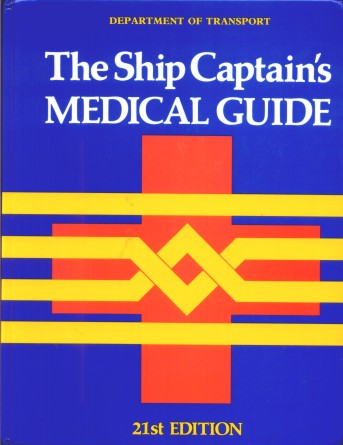
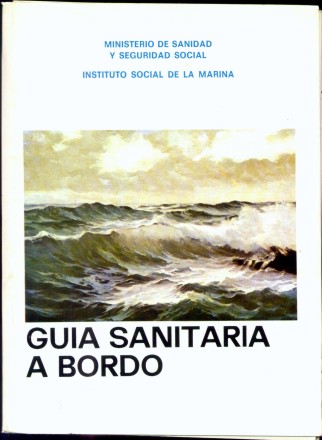
reprinted in 1992, 1994, 1996 ... and now WHO has begin to work in the 3rd new edition with a committe of experts and the support of IMHA (International Maritime Health Association). Let's see some of the Guides: International, British and the 3 editions of the Spanish one (Visit the website of ISM, the editor of the last 3rd edition in this link).
Following
these guidelines, the ISM ("Instituto Social de la
Marina", or Mariners' Social Institute) decided to
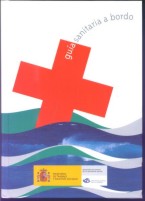
produce a national "Guía Sanitaria a
bordo", for Spain, the first edition
appearing in 1976: the second edition (1987) was revised
and the resulting version published in November, 2001.
Its clear language, easily intelligible for professionals
not specialized in health care, together with the large
number of colour illustrations and diagrams, make it an
accessible book. The Health Care Guide is intended to aid
medical consultation by radio, and, through easy
reference, enable basic health care and anticipate most
frequent situations regarding accidents or disease. The
second edition in 1987 had 11 chapters. The actual one is
composed by several sections: emergencies, urgencies ...
In Spain a Presidential Decree (4th of
December 1980) established the types of medical supplies
which must be carried by national merchant ships and
fishing boats, according to their activity, as stipulated
in the Organic Regulations of the Department of Overseas
Health and in accordance with the norms of the
International Agreement for the Safety of Human Life at
Sea. Four types of medical supplies were stipulated;
numbers 1, 2, 3 and 4, whose contents and
characteristics vary depending on the activity, the route
of navigation etc. The above-mentioned
norms were updated at the European level and particularly
in relation to the contents of the medical supplies
applying Directive 92/29/CEE of the Council of the
European Communities (31st March 1992), which issued
guidelines on "MINIMUM SAFETY AND HEALTH
REQUIREMENTS TO PROMOTE IMPROVED MEDICAL CARE ON BOARD
SHIPS". Spain has recently published the
transposition of the latter in the "BOE"
(official state Gazette) in RD 258/99 (BOE, 24th February, 1999)
which also includes regulations on health care training
clearly related to the STCW - IMO Agreement (1995). Three
types of medical chest A, B and C are stipulated,
as is the responsibility for regular in-service training
in first aid and the use of medical supplies (refresher
courses every 5 years). Let's see also the Let's consult the
content of the WHO recommended medical chest class A list
of medicines
and other medical supplies The
effectivenessof medical care on board will mostly depend
on the medical supplies, therefore it must be ensured
that these are in perfect condition, that is: 1. Well
equipped. - The better the equipment, the better and more
comprehensive the medical care will be. The person in
charge of the medical supplies should take note of all
that has been used in order to know exactly what must be
replaced on arrival at port. 2. Suitably
arranged. - So that any item can be found as quickly as
possible, particularly in case of emergency, where fast
and orderly action can be vital. 3. Suitably
located. - In a clean dry place, protected from the
environmental changes that affect drugs. 4. Suitably
stored. - It is advisable to appoint a crew member
responsible for medical supplies, who will be in charge
of the fulfilment and maintenance of the above-mentioned
aspects. Medical supplies must be well protected in order
that unwarranted use is not made of medicines. The equipment
established for each type of medical supplies is based on
minimum requirements and the shipping or shipbuilding
companies can increase the amount of each product and
even the number of products, provided that they are not
toxic or narcotic, in which case they must not exceed the
amount indicated for each type of medical supplies. The fact that a large number of commercial names are used when listing medicines for medical supplies, due to the impossibility of mentioning the formulae of certain products, does not imply the exclusion of other similar medicines. Therefore, for stock control of medical supplies, any other product with a similar composition and identical applications to those on offical lists will be considered acceptable. |
|